

Eliminate extra reducer fittings and leakage points with precision-machined reducing weld neck flanges engineered for municipal water, HVAC, fire protection, and industrial process plumbing. Get factory-direct pricing with rapid global delivery.
Eliminate extra reducer fittings and leakage points with precision-machined reducing weld neck flanges engineered for municipal water, HVAC, fire protection, and industrial process plumbing. Get factory-direct pricing with rapid global delivery.
✔ ISO 9001 Factory | ✔ ASME B16.5/B16.48 Compliant | ✔ 20+ Export Countries
In the water plumbing industry, every reducer, every adapter, every extra joint is a potential failure point — and a hidden operating expense. Here is what procurement and engineering teams commonly face:
Buying a standard weld neck flange plus a separate reducer fitting inflates your BOM by 18–30% per joint compared to a single reducing weld neck flange.
Each additional welded or threaded joint is a potential leak path. In a 10,000 ft water pipeline, eliminating just one joint per 100 ft can reduce leakage risk dramatically — but the industry often adds unnecessary ones.
Sourcing flanges and reducers from different suppliers multiplies freight costs and complicates logistics. Lead times stretch by 2–4 weeks, causing costly project delays.
Forged carbon steel flanges from low-cost suppliers often lack material traceability, causing unexpected brittle failure under cyclic water pressure.
Each additional fitting requires extra welding passes, bolting, and inspection time. Field labor rates push the cost of a single flanged reducer connection to $120–$250 on-site.
Municipal water projects demand full traceability (PMI, heat numbers, MTR). Overseas suppliers without documentation force re-testing costs of up to $500 per lot.
The solution? A single, engineered component — the reducing weld neck flange — that replaces two parts.
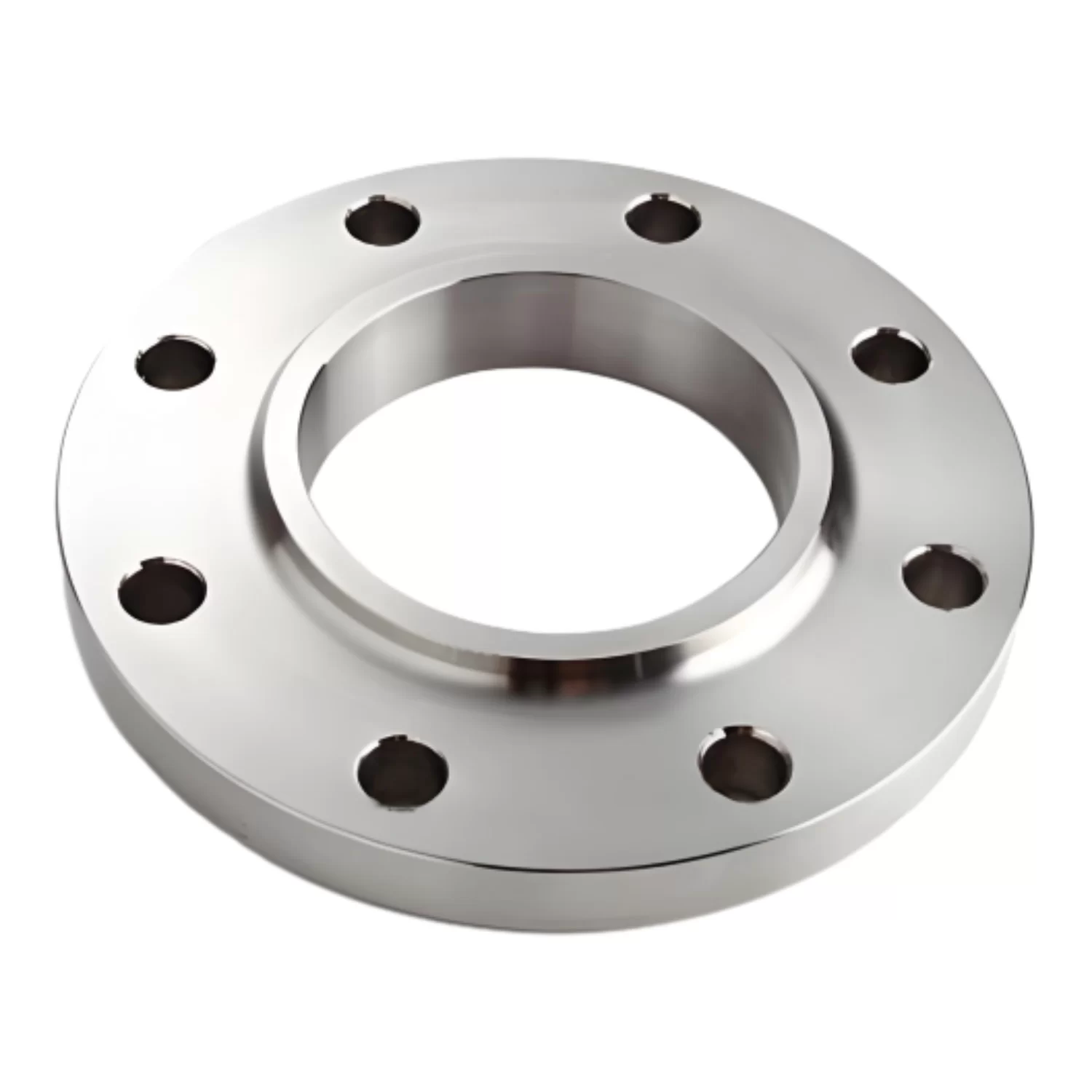
A reducing weld neck flange is a forged pipe flange with a tapered hub and a bore diameter smaller than the standard pipe bore it connects to — matching the inlet of a smaller downstream pipe. Instead of installing a standard flange and a reducer coupling (or butt-weld reducer), the reducing weld neck flange achieves the size transition within a single forged component. This also significantly reduces the total number of welds and potential leak paths in a water piping system.
Per the functional engineering principle behind pipe fittings, a reducer coupling performs the same job as a reducer but for threaded systems — yet for welded high-pressure mains, a reducing weld neck flange is the technically superior alternative. It combines the structural strength of a full-penetration butt weld with a smooth, gradual bore transition that minimises turbulence and pressure drop in water plumbing systems.
Single-piece forging eliminates weld seams between flange and reducer, improving structural integrity. Enjoy 37% fewer potential leak points versus flange-plus-reducer assemblies.
Manufactured to ASME B16.5 and MSS SP-44 dimensional standards, covering NPS ½" through 24" in pressure classes 150, 300, 600, 900, 1500 and 2500. Full traceability per ASTM A105 / A182.
Gradual taper transition reduces turbulence and pressure drop by up to 22% compared to abrupt reducer fittings. This directly cuts pumping energy cost in water systems.
ASTM A105 carbon steel (standard), A350 LF2 for low-temp, and A182 F304/F316/F316L for aggressive chlorinated or desalinated water. RoHS & REACH compliant material sourcing.
As a China-based factory, we deliver 25–40% lower unit cost than EU/US mills on equivalent ASME flanges. Avg. lead time 15–30 days; 48h samples available.
Optional fusion-bonded epoxy (FBE), hot-dip galvanized, or zinc-rich primer for potable water / wastewater environments. Compliance with NSF/ANSI 61 available on request.
The following tables summarise key specifications our engineers use to configure reducing weld neck flanges for water plumbing systems. All dimensions comply with ASME B16.5 unless otherwise stated.
| Parameter | Specification / Options |
|---|---|
| Design Standard | ASME B16.5 (NPS ½" – 24"), MSS SP-44 (NPS 26" – 60"), EN 1092-1 (DN15 – DN600) |
| Pressure Class | 150#, 300#, 600#, 900#, 1500#, 2500# |
| Carbon Steel | ASTM A105 (≤ 425°C), ASTM A350 LF2 (≤ -46°C) |
| Stainless Steel | ASTM A182 F304/F304L, F316/F316L, F321 |
| Alloy Steel | ASTM A182 F11, F22, F91 for high-temp applications |
| Face Finish | RF (125–250 µin Ra), FF, RTJ (serrated / smooth per ASME) |
| Coating | FBE, HDG, zinc-rich primer, oiled, bare |
| Testing | Hydrostatic, pneumatic, PMI, Dye Penetrant, UT per request |
| NPS (Large End) | NPS (Reducing End) | Flange OD (mm) | Bore Ø at Small End (mm) | Hub Length (mm) | Bolt Circle Ø (mm) |
|---|---|---|---|---|---|
| 2" (DN50) | 1" (DN25) | 152 | 26.6 | 64 | 120.7 |
| 4" (DN100) | 3" (DN80) | 229 | 78.0 | 76 | 190.5 |
| 6" (DN150) | 4" (DN100) | 279 | 102.6 | 89 | 241.3 |
| 8" (DN200) | 6" (DN150) | 343 | 153.9 | 102 | 298.5 |
| Temp (°C) | Class 150 (bar) | Class 300 (bar) | Class 600 (bar) | Class 900 (bar) |
|---|---|---|---|---|
| 38 | 19.6 | 51.1 | 102.1 | 153.3 |
| 93 | 17.9 | 46.6 | 93.2 | 139.8 |
| 149 | 15.8 | 41.4 | 82.7 | 124.1 |
| 204 | 13.8 | 36.2 | 72.4 | 108.6 |
| 260 | 11.7 | 31.0 | 62.1 | 93.1 |
Note: Values above are working pressures in bar gauge. For potable water at ambient temperature, Class 150 flanges are commonly specified. Higher classes could be over-specification — request our engineering team for help.
Flanged joints are critical discontinuities in a piping system. For bolted flange joints, reduced-order dynamic models have been developed to capture nonlinear contact behaviour at flange interfaces — equivalent stiffness representations enable accurate system-level vibration prediction without costly full-contact simulations. This has direct implications for water pumping stations where cyclic loads are prevalent. 【Simplified Nonlinear Dynamic Model for Pipe Structures with Bolted Flange Joints – DOI link – Luan et al. (2012) developed equivalent stiffness models for bolted flanges.]
In piping systems, sustained stress indices (SSIs) are used to account for stress intensification at elbows, tees, and other geometric discontinuities. Understanding these factors is critical when configuring a reducing weld neck flange near a tee branch connection — because the local geometry directly affects fatigue life. 【Sustained Stress Indices at Tee Connections in Piping Systems – ScienceDirect – Used in beam-type analyses to estimate primary stress intensification per ASME B31.]
A 2025 decision matrix framework evaluates mechanical properties, corrosion resistance, thermal stability, and cost-effectiveness of alloy options for rigid flange coupling systems. For water systems with moderate chlorine, over-specifying stainless steel when FBE-coated carbon steel suffices can inflate project cost by 3–5×. 【Performance Material Selection in Rigid Flange Coupling Systems – Cureus J. Eng. 2025 – Optimises alloy choices, reducing over-specification waste.]
A reducing weld neck flange for water plumbing systems is not limited to one niche. It appears in every scenario where pipe size changes under pressure:
Transitioning from a 12" transmission main to an 8" district supply line. Class 150 carbon steel, FBE-coated. Our client reported a 28% cost saving versus their previous flange+reducer sourcing approach.
Power plant cooling-water loops with 300# class flanges. Stainless A182 F316 for chlorinated water. Lead time: 18 days from PO to Shanghai port.
Fire pumps discharge to distribution mains often require 6" × 4" reducing flanges. ASTM A105 with red epoxy primer. Listed as acceptable by major US insurers when supplied with UL/FM documentation.
High-volume pivot systems using 8" × 6" reducing flanges on aluminium-bronze or galvanized carbon steel. One cooperatives saved $4,200 on a 200-flange order by combining two SKUs into one.
Applied 36 units of 6" × 4" Class 600 RF reducing weld neck flanges ASTM A105 + FBE coating. Result: 31% cost reduction versus locally sourced flange + reducer pairs, and installation time cut by 1.5 days per skid.
Procured 90 units of 12" × 8" Class 150 A105 reducing weld neck flanges for a water main expansion. Weihuan delivered in 22 days, beating the project deadline by a week, with attached MTR & PMI documentation accepted by the AHJ.





"We had been sourcing flanges and reducers separately from two brokers. Switching to Weihuan's reducing weld neck flange cut our component cost by 31% and simplified logistics. The PMI documentation was complete, and their QA team answered every audit question."

"Their 8"×6" Class 300 reducing flanges arrived 3 weeks ahead of schedule. We fitted 120 units without a single re-work. The FBE coating showed zero defects under holiday spark testing. Very impressed by the factory's consistency."

"CRITICAL factor: the flanges matched our legacy piping perfectly. We measured bolt holes, hub OD, and face finish. Everything fell within ASME tolerances. One-piece design saved us a week of welding time on site."

"Weihuan is the only supplier we found who could deliver NSF 61 certified reducing weld neck flanges for potable water at a competitive price. Their ERP integration with our POs made ordering painless. We've placed 5 repeat orders."

"The 6"×3" Class 600 reducing weld neck flanges for our pump station were exactly to spec. Helped resolve a chronic vibration issue because the shorter joint stacks reduced the excitation arm. Great technical support."
"The tapered hub geometry is well forged — ultrasonic testing came back clean. Far better than similar products we sourced from other Asian suppliers. Would recommend for high-pressure water and fire systems."
A reducing weld neck flange has a smaller bore diameter at the hub inlet than its mating pipe's nominal bore. In contrast, a standard weld neck flange has a bore that matches the pipe OD exactly. The reducing flange effectively combines a flange and a reducer into one forging, allowing a transition from a larger pipe to a smaller pipe (or valve/equipment inlet) at a single joint.
Our flanges are manufactured in compliance with ASME B16.5 (NPS ½"–24") and MSS SP-44 (NPS 26"–60"). Where international projects require European compliance, we also produce to EN 1092-1. Dimensional inspection reports can be issued per ISO 9001 quality procedures.
Yes. For chlorinated or aggressive water, we offer A182 F304/F316/F316L stainless steel. We can also certify compliance with NSF/ANSI 61 for products used in potable water systems. For standard municipal water, FBE-coated A105 is usually more economical — our engineering team can advise based on your water chemistry data.
For standard sizes from stock, we accept orders from as low as 5 pieces. For custom forged sizes or special materials (e.g., F91, Inconel), MOQ typically starts at 20 pieces. However, we encourage procurement teams to send their full flange package — we can bundle different sizes and materials into a single container to reduce freight cost.
For bulk orders, we use sea freight FOB / CIF terms. A 20ft container loaded with 5–8 tons of flanges typically costs $1,200–$2,500 to US Gulf / West Coast ports. Production time is normally 15–30 days, and sample orders ship by DHL/FedEx in 5–7 days.
Yes, we supply free samples for standard sizes with the customer covering express shipping costs. Custom-made samples are available at a nominal fee, fully refundable when you place a formal production order. Sample documentation includes MTR, dimensional report, and PMI certificate where applicable.
Absolutely. Our engineering team uses CAD & finite element analysis (FEA) to design custom hub tapers and bore profiles for unique pressure or temperature conditions. We have delivered custom solutions for clients in desalination, high-temperature water injection, and wastewater processing. Share your P&ID or datasheet and we will revert with a technical proposal within 48 hours.
We accept L/C (letter of credit), T/T wire transfer, and for small orders, PayPal or Western Union. Long-term contract buyers can apply for net 30/60 terms after credit evaluation. Our invoicing supports USD, EUR, and RMB settlements.
Get a custom quote with a full spec sheet within 24 hours. Mention the code "RF2026" to receive a free flange material selection guide.
📧 Email: whxs@weihuantube.com · 🌐 https://www.weihuantube.com/contactus/
Your inquiry is protected under our privacy policy. We reply within 24 business hours.
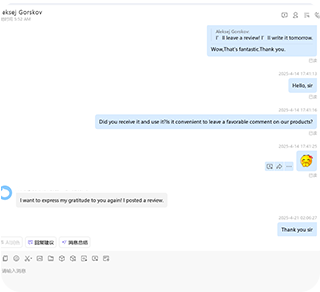
Screenshots from recent customer consultations (identities blurred for privacy).



Zhang Wei — Senior Applications Engineer at Cangzhou Weihuan Pipeline Equipment Co., Ltd. With 14 years of experience in pipe flange design, forging process optimisation, and international project support, Wei has provided technical guidance for water infrastructure projects in 20+ countries across North America, Europe, the Middle East, and Africa. He is a member of the local ASME Boiler & Pressure Vessel Code discussion group.
Disclaimer: All product specifications and data provided in this article are for general reference. Final specifications should be confirmed against the contract drawings and applicable standards. Figures cited reflect typical performance and project-specific outcomes; actual results may vary depending on installation conditions and third-party variables.

May 25,26
A welded tee is a pipe fitting designed to connect three sections of pipe together. It forms a T-shaped structure where one branch pipe joins the main run pipe at a 90-degree angle. Depending on the application, pressure level, material grade, and fabrication method, there are several different types of welded tees available in the market.

May 25,26
Difference Between 45 Degree and 90 Degree Elbow
Choosing the correct elbow type is important for improving pipeline efficiency, reducing turbulence, minimizing maintenance, and optimizing overall system design. Whether in oil and gas pipelines, HVAC systems, chemical plants, plumbing networks, or water treatment facilities, understanding the difference between 45° and 90° elbows helps engineers and buyers make better piping decisions.

Jun 08,26
High Performance Slip Blinds Flanges for Industrial Piping Safety

Oct 01,26
High Performance China Long Bend Pipe Fittings Guide
In industrial piping, the transition of fluid direction is a critical engineering challenge where the choice between long and short radius bends determines the entire systems efficiency. A long radius LR bend, typically defined by a centerline radius of 1.5 times the nominal pipe diameter, is engineered to minimize turbulence and reduce the energy required for pumping. This technical guide examines the specifications, material requirements, and procurement strategies for sourcing high-performance pipe fittings. For procurement managers in the oil, gas, and chemical sectors, the primary objective is to balance total cost of ownership with strict adherence to safety standards

Sep 21,26
High Performance C70600 China blind flange for Marine Systems
When specifying high-performance sealing components for corrosive environments, the choice of material and manufacturing precision directly determines the operational lifespan of the entire pipeline. For systems handling seawater, acidic brine, or chemical processing, standard carbon steel or low-grade alloys often fall short, leading to pitting and catastrophic failure. This is where C70600 9010 Copper-Nickel alloys become essential, providing a critical balance of mechanical strength and exceptional resistance to biofouling and chloride-induced corrosion. Our C70600 weld neck flanges are engineered specifically for critical infrastructure, including desalination plants and offshore platforms.
Apr 03,26
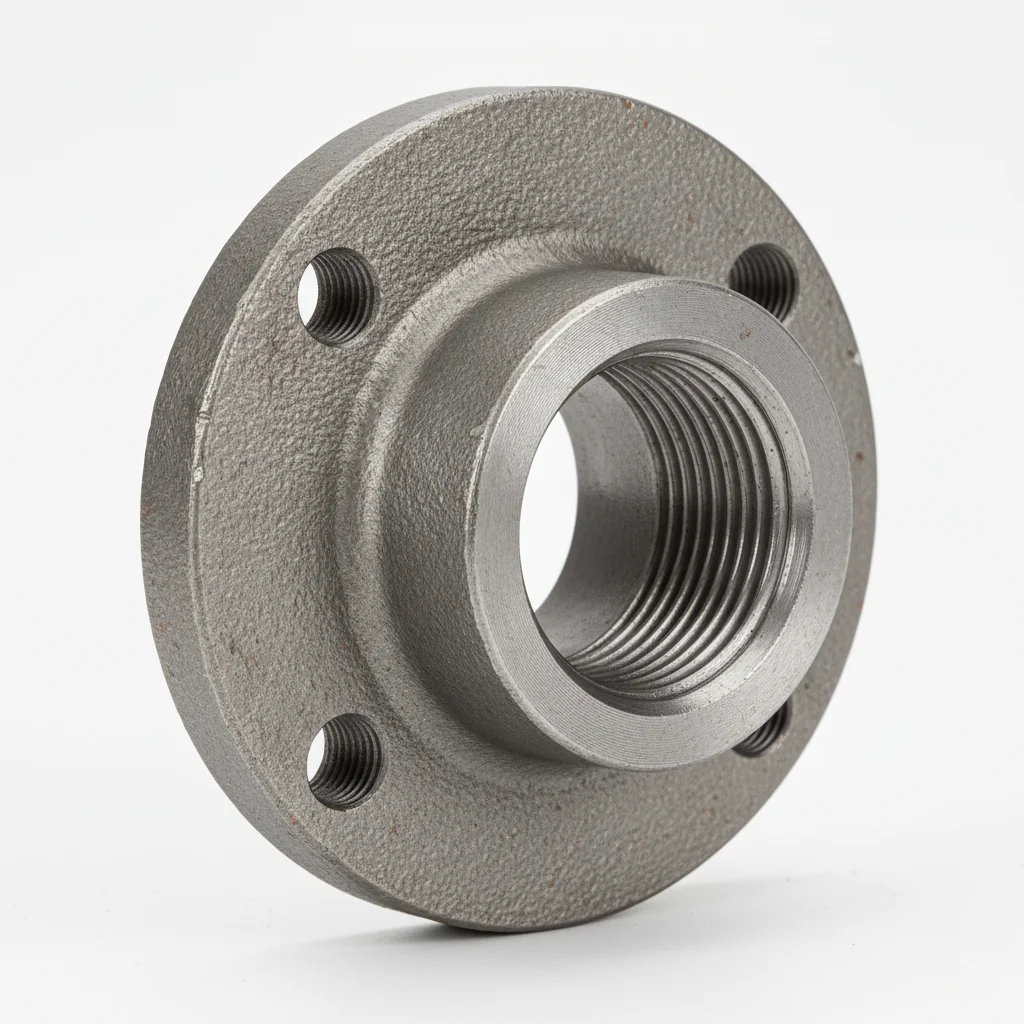
The Indispensable 50mm Threaded Flange for Reliable Industrial Connections
SUBSCRIBE NEWSLETTER